There is always a certain amount of excitement when introducing a new fish into an established aquarium. Even after decades of keeping aquariums, I still find myself watching every interaction, wondering how the newcomer will settle in and whether the existing residents will accept their new companion.
Yesterday it was Roja’s turn.
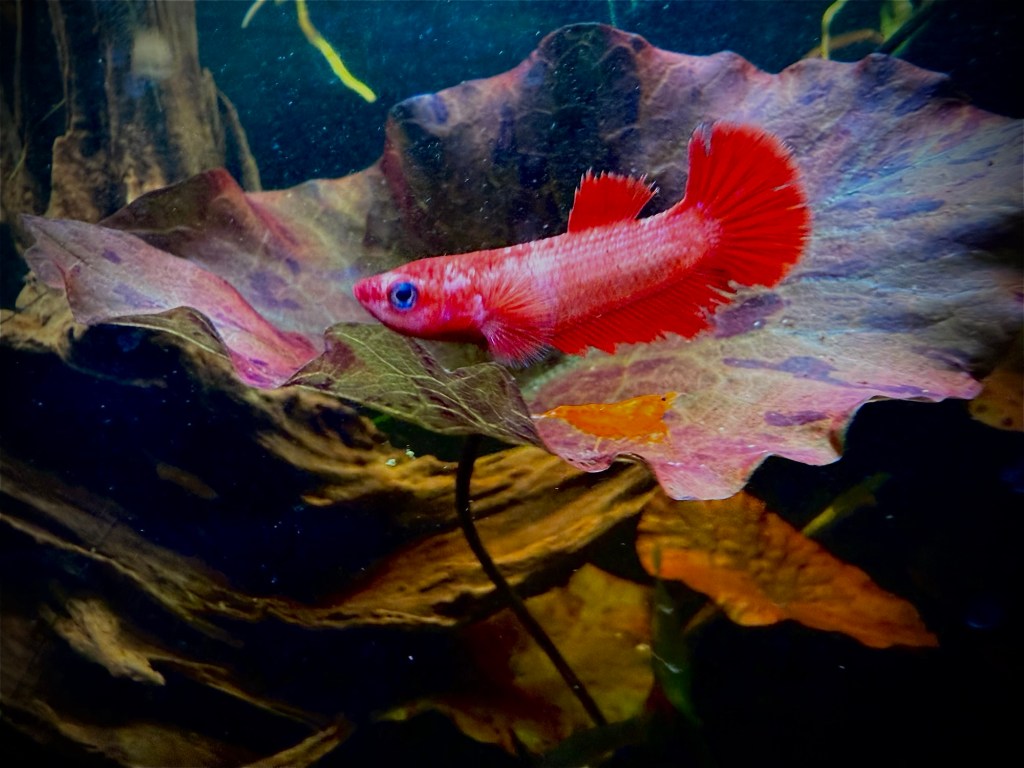
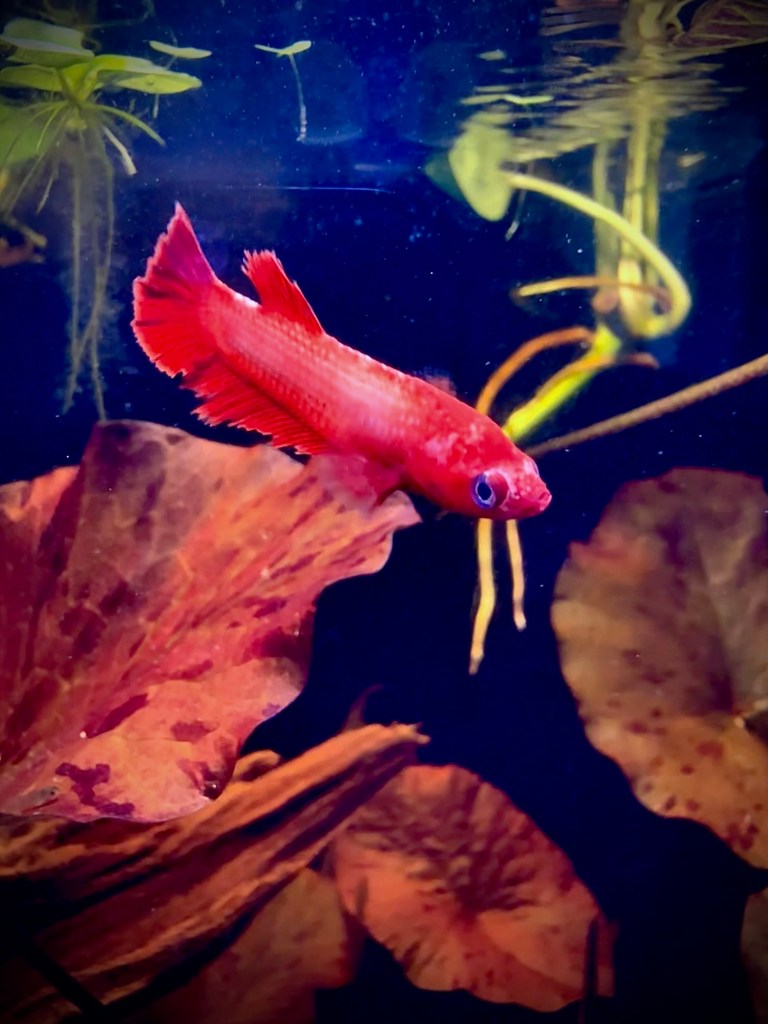
Roja is a female Siamese fighting fish (Betta splendens), and she immediately became the centre of attention in my little aquarium. Although female bettas are often described as more modestly coloured than males, that certainly does not apply to her. She is predominantly a rich, deep red, while parts of her body shimmer with white that catches the light from different angles. Her bright blue eyes complete the appearance, giving her an alert and curious expression that seems to follow everything happening around the aquarium.
When I purchased Roja, I also brought home a male betta at exactly the same time. I have kept fish for many years, so I knew that introducing a male and female together can sometimes be unpredictable. Siamese fighting fish have earned their reputation for a reason, and although females are generally less aggressive than males, every individual has its own personality.
Fortunately, my concerns proved unnecessary.
The two fish settled surprisingly quickly. Rather than constant chasing or territorial disputes, they established a respectful balance almost immediately. The only time Roja truly insists on her place is during feeding. She has absolutely no hesitation in standing her ground, and if the male becomes too enthusiastic, she quickly reminds him that she deserves her share of the food. The brief displays are over within seconds, and both fish return to peacefully exploring the aquarium.
Watching Roja over her first day has revealed far more than simply a beautiful fish.
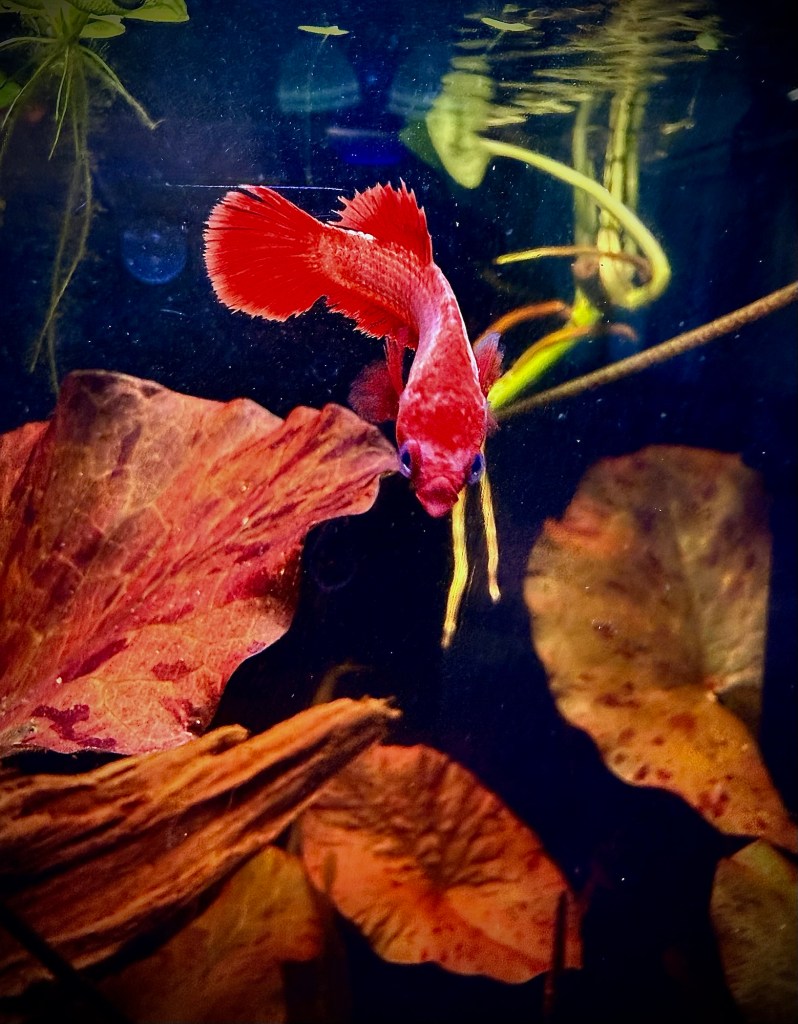
She is intensely curious.
Almost from the moment she entered the aquarium, she began inspecting every corner of the planted layout. Instead of remaining near the surface, she carefully explored the dense vegetation, weaving through leaves, examining pieces of driftwood and searching every gap between the plants. It quickly became clear that she is an active hunter, constantly looking for tiny movements among the stems and mosses.
This naturally makes life a little more exciting for my Endler fry and the cherry shrimp.
Every now and then Roja notices a tiny shrimp or a young Endler darting through the plants and immediately investigates. Fortunately, she does not seem excessively aggressive. Rather than relentlessly chasing everything that moves, she simply follows her natural instincts. Most of the time she slowly patrols the aquarium, investigating anything that catches her attention before moving on.
For a community aquarium, this balance is exactly what I had hoped for. She behaves like a predator without becoming a bully.
The Siamese fighting fish originates from Southeast Asia, particularly Thailand, Cambodia and neighbouring countries. In the wild they inhabit shallow rice paddies, slow-moving streams, canals and floodplains where warm, calm water is filled with aquatic vegetation. These environments are often low in dissolved oxygen, and over thousands of years bettas evolved one of their most remarkable features: the labyrinth organ.
This specialised breathing organ allows them to take oxygen directly from the air at the water’s surface. It is one of the reasons why bettas can thrive in habitats that would be difficult for many other fish species. Despite this adaptation, they still appreciate clean, well-maintained aquariums with stable water conditions and plenty of places to explore.
The Halfmoon variety is among the most popular forms of domesticated Betta splendens. The name comes from the spectacular shape of the tail when fully spread. Ideally, the caudal fin forms a smooth 180-degree semicircle resembling a perfect half moon. Selective breeding over many decades has produced an astonishing range of colours and finnage, from solid reds and blues to marbled, metallic and multicoloured patterns.
Roja belongs to what was described as the Halfmoon FT variety. The abbreviation FT is commonly used by breeders and retailers to indicate Fancy Tail, referring to long-finned ornamental bettas with especially elaborate finnage and colour combinations. In practice, it distinguishes these elegant long-tail forms from the shorter-finned plakat varieties. While the exact terminology may vary slightly between breeders, it generally denotes a decorative long-fin form.
As I sit watching the aquarium today, it finally feels complete.
The Endlers are constantly active in the upper water, the shrimp continue their endless search for food among the plants, the snails slowly make their rounds, and the pair of bettas have already established themselves as the unmistakable stars of the aquarium. Roja patrols the plants with endless curiosity, while the male glides gracefully through the open water.
Every aquarium eventually reaches a moment when everything seems to fall into place. The plants have grown in, the biological balance has stabilised, and every inhabitant has found its own place in the miniature ecosystem.
With Roja’s arrival, I have the feeling that this little pond has finally become exactly what I imagined when I first began building it.

