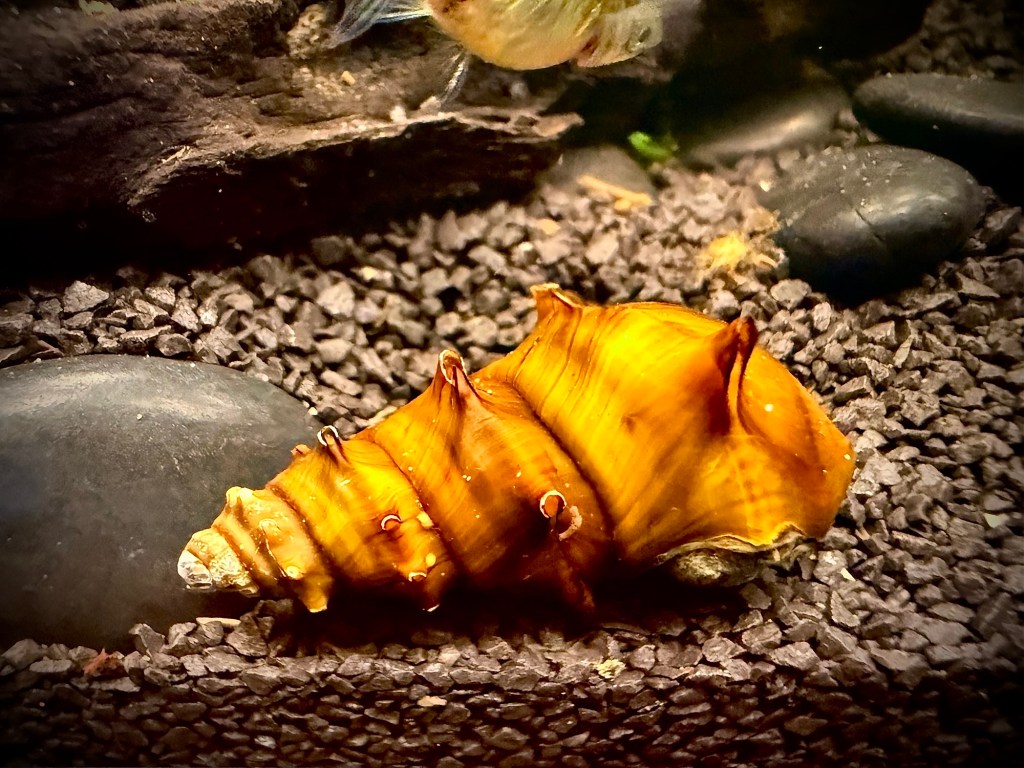
Of all the snails living in my aquarium, the Spiny snail is certainly one of the most unusual looking. I currently have two of them. They are also my largest snails, and looking at their heavy, sculptured shells, they seem almost prehistoric compared with some of the smaller and more delicate snail species.
Their scientific name is Brotia pagodula. They are also commonly known in the aquarium hobby as Pagoda snails, Horned Armour snails or Porcupine snails. It is easy to understand these names when looking at the shell. Instead of being smooth and rounded, it has pronounced ridges and pointed projections arranged around its conical shape. Each individual seems slightly different, which makes them particularly attractive animals to watch and photograph.
My two Spiny snails are very peaceful. They move slowly around the aquarium, spending their time exploring the bottom, decorations and other surfaces. There is nothing hurried about them. Compared with some of my other snails, which can sometimes travel surprisingly quickly when they decide to go somewhere, these two seem to take life at their own pace.
They also have one habit that still manages to frighten me occasionally. Every now and then, one of them simply stops moving and stays in exactly the same place for a very long time. Sometimes this can last for most of a day. I inevitably start wondering whether something has happened to it, only to discover later that the snail has apparently decided its rest is over and is moving around normally again. Long periods of inactivity are actually quite normal for this species, although knowing that does not completely stop. me from checking them.
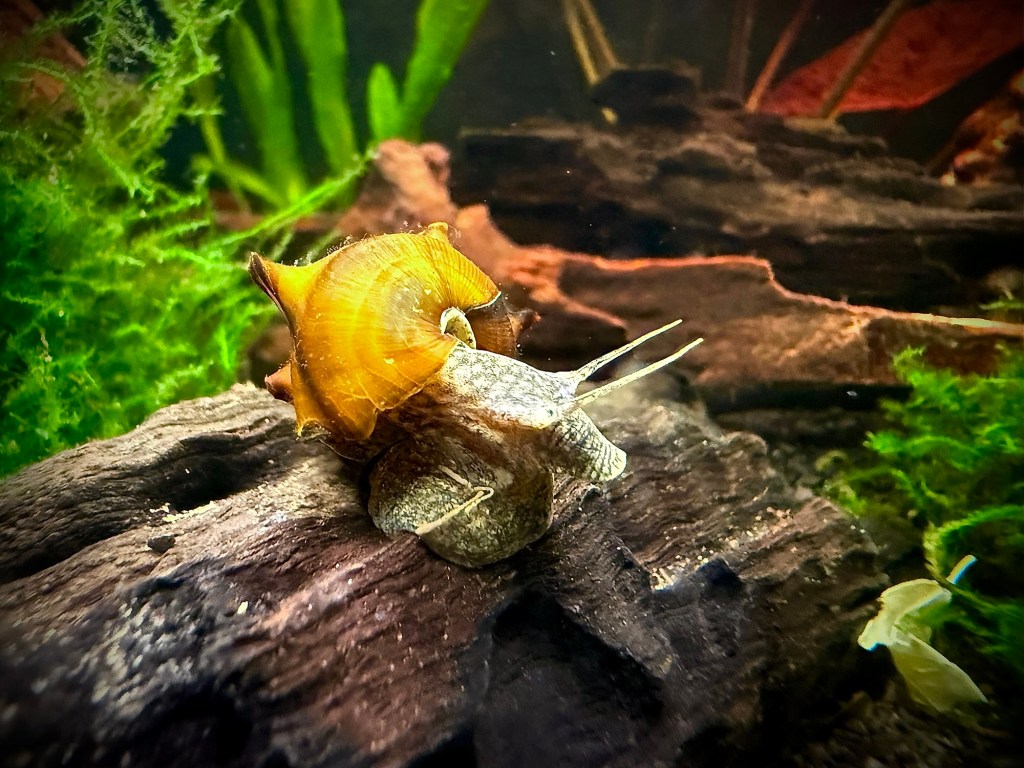
Brotia pagodula originates from Southeast Asia and has a particularly interesting natural distribution. It is associated with the Moei River system along the border between Thailand and Myanmar. In nature these snails live in flowing freshwater environments, so they appreciate clean, well-oxygenated water. Their natural habitat also helps explain their strong, substantial appearance. This is not a fragile-looking little pond snail but an animal clearly adapted to life in rivers and streams.
The species was scientifically described in the nineteenth century, and its distinctive shell is responsible for one of its other common names, “Pagoda snail”. Viewed from the side, the different levels and projections of the shell do indeed resemble the tiers of an Asian pagoda. Adults commonly reach around four to five centimetres in length, although there is some variation between individuals. In a small aquarium that makes them surprisingly impressive animals.
Their lifespan is generally estimated at several years, with around three to five years often given under good conditions. As with many aquarium invertebrates, actual lifespan depends greatly on water quality, food and the conditions in which the animal lived before arriving in the aquarium.
They spend much of their active time grazing over surfaces and searching for small particles of food, algae and organic material. In an aquarium they can also accept various sinking foods and vegetable matter. They are peaceful towards other inhabitants and do not have the rapidly multiplying reputation of some smaller freshwater snails. An interesting difference is that Brotia pagodula is live-bearing rather than simply covering the aquarium with clusters of eggs. Males and females are separate, and reproduction in an aquarium tends to be relatively slow.
For me, their size is both part of their attraction and probably the limit of what I want in this aquarium. My two Spiny snails fit in very well and have plenty of room to move around, but they are already large compared with most of the other snails I keep. I do not think I would want to introduce anything significantly larger. In a modest-sized aquarium, even a four or five centimetre snail has a considerable presence.
Despite their size, they are wonderfully unobtrusive animals. They do not disturb the other inhabitants and simply continue their slow exploration of the aquarium. Their unusual shells make them easy to spot, while their calm behaviour gives them a completely different character from the fish and shrimps around them.
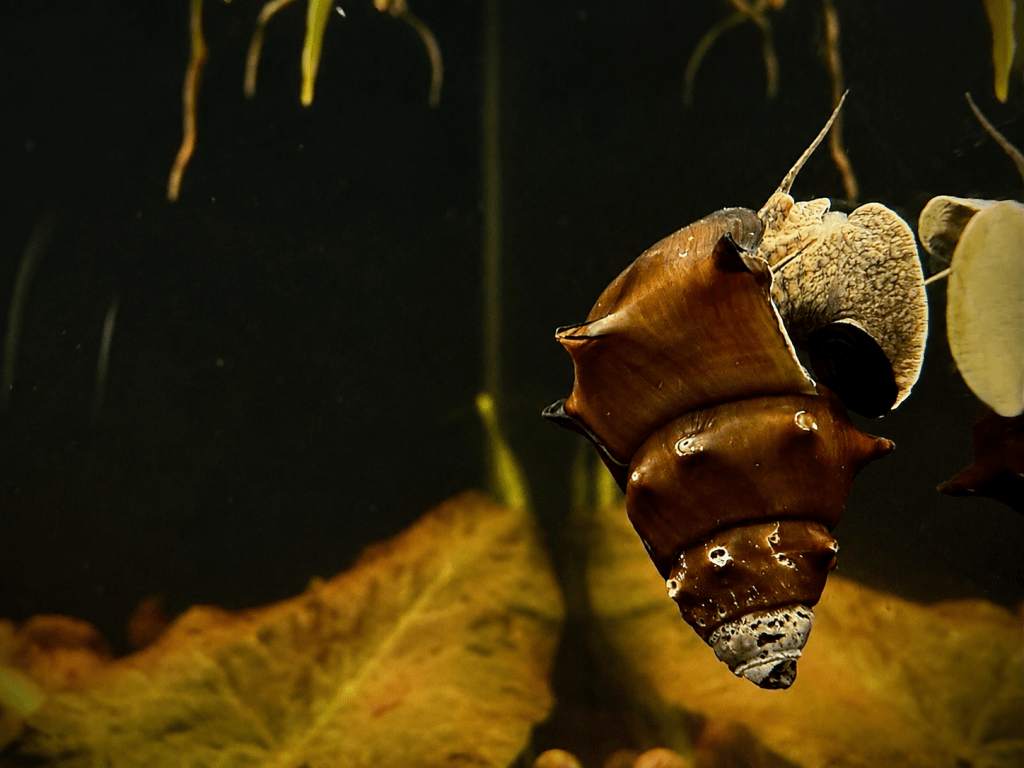
I have become very fond of my two Spiny snails. They may occasionally give me a small shock by pretending to be dead for a day, but sooner or later they always start moving again as if nothing happened. Perhaps that is part of their charm. They are slow, peaceful, slightly strange and very beautiful – exactly the sort of inhabitants that make an aquarium interesting to observe every day.
 Little pond in the north