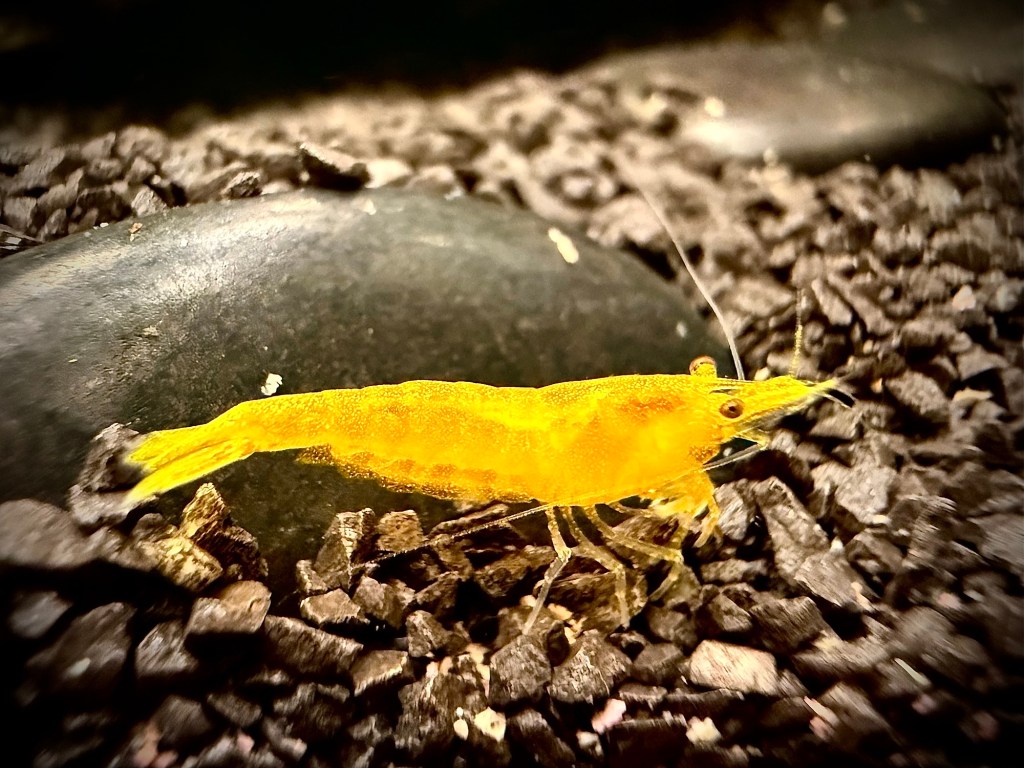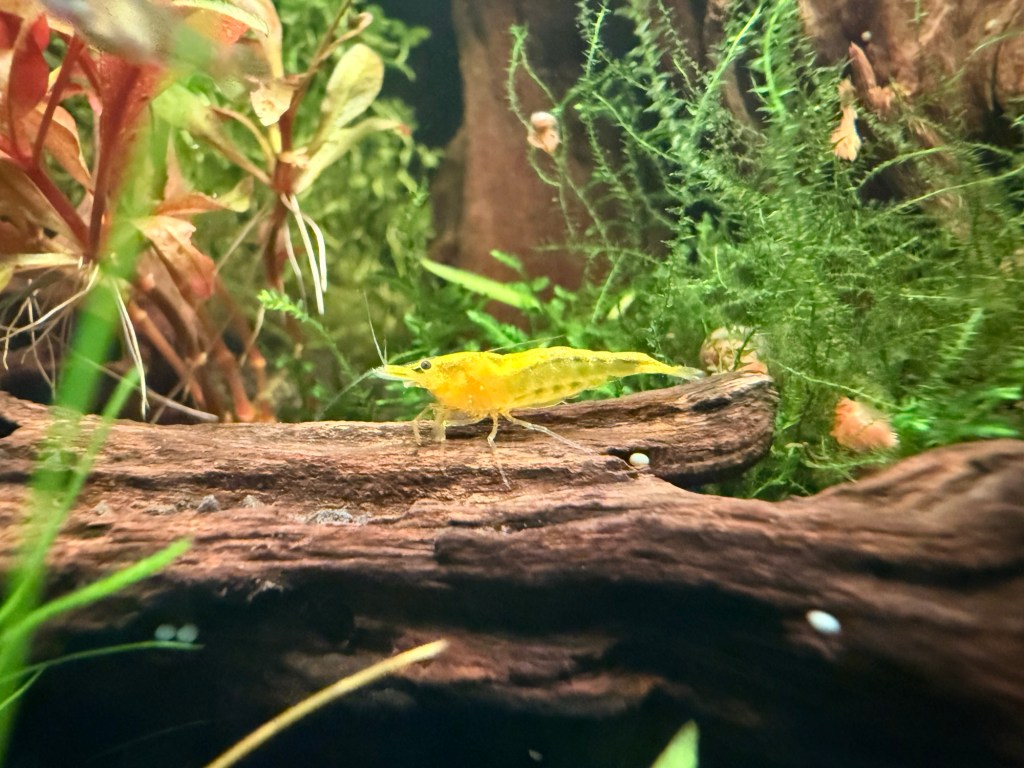
The Yellow Fire Shrimp is one of the most striking freshwater shrimp I have added to my aquarium. Its bright yellow colour makes such a small animal surprisingly easy to notice, especially when it is moving among green plants or across darker parts of the aquarium. I currently keep several different colours of shrimp, including red, orange and yellow varieties, and so far all of them seem to be doing very well.
The scientific name of the Yellow Fire Shrimp is Neocaridina davidi. This is actually the same species as the familiar Red Cherry Shrimp and many of the other colourful Neocaridina varieties found in aquarium shops. The differences between them are largely the result of selective breeding. Over many generations, breeders selected shrimp showing particular colours and continued breeding the most attractive individuals. This has eventually given aquarium keepers an extraordinary selection of red, orange, yellow, blue and other colour forms.
The wild ancestors looked quite different. Neocaridina davidi originates from East and Southeast Asia, with its natural distribution including areas of China, Taiwan, Korea and Vietnam. Wild shrimp are generally much less colourful than the aquarium varieties. Their transparent, greyish, brownish or greenish-brown appearance provides useful camouflage among stones, plants and decaying vegetation.
The brilliant Yellow Fire Shrimp therefore isn’t something that developed simply because the shrimp lived in a particularly colourful river somewhere in Asia. Its intense yellow appearance is the result of selective breeding within the aquarium hobby. The yellow variety is also sometimes called Yellow Sakura, and different breeding lines can vary considerably in colour. Some individuals are relatively translucent yellow, while high-quality Yellow Fire shrimp can have an almost completely opaque, brilliant lemon-yellow or golden body.
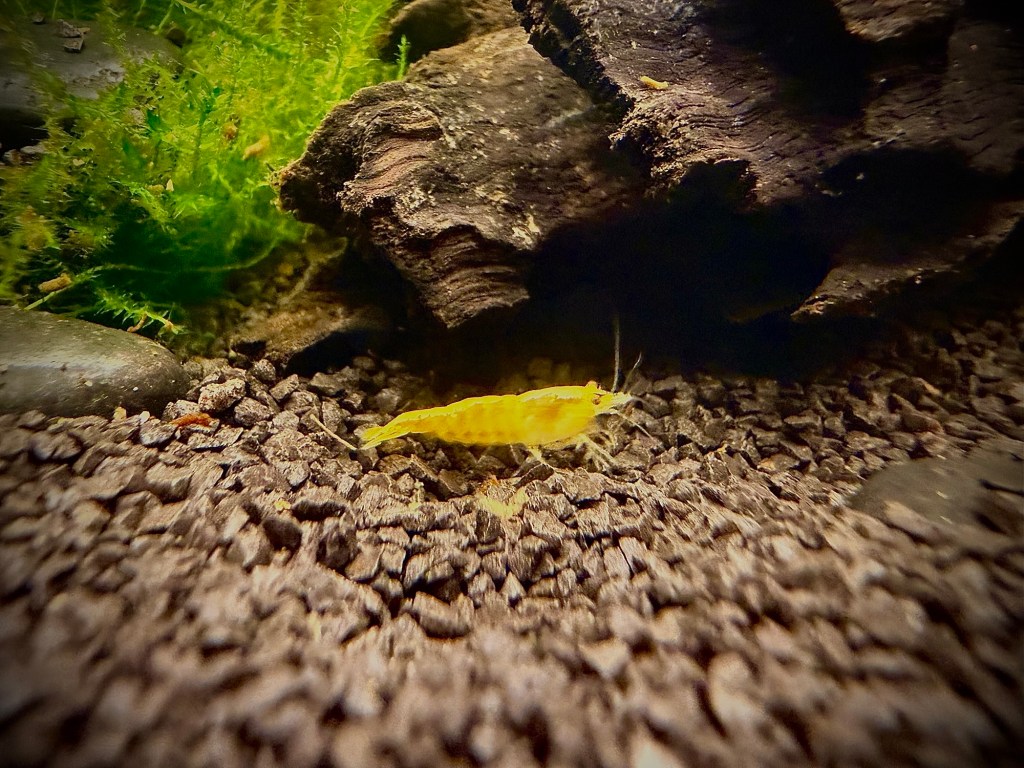
One of the things I enjoy most about keeping Neocaridina is watching them work their way around the aquarium. They seem to be constantly busy. They walk across leaves, wood, stones and the bottom of the aquarium, picking at surfaces with their tiny front legs. Much of what they are eating is almost invisible to us: algae, microorganisms, biofilm and tiny pieces of organic material.
My red, orange and yellow shrimp all appear comfortable in the aquarium. An interesting part of my experience has been how well they seem to coexist with the fish. Even the bettas have not caused any problems. Of course, keeping shrimp together with fish always involves some risk, particularly for very small juvenile shrimp, but the adult shrimp in my aquarium seem confident enough to move around normally rather than spending their entire lives hiding.
I have recently added more low-growing and covering plants to the bottom of the aquarium. I hope this will make the environment even better for the shrimp. Dense vegetation provides shelter and also creates enormous amounts of additional surface area on which biofilm can develop. If the shrimp eventually reproduce, these protected areas should be particularly useful for the tiny newborn shrimp.
So far, mine have not reproduced. That may simply be a matter of time. Neocaridina are famous for becoming quite prolific once they are comfortable and mature. Unlike many shrimp species, their young do not need a marine or brackish-water stage. The females carry their eggs beneath the abdomen, constantly moving water around them with their swimmerets. Eventually, miniature versions of the adults emerge and begin life directly in the freshwater aquarium.
There is one interesting complication when keeping several Neocaridina colours together. Red, orange and yellow shrimp are different colour forms of the same species, so they can breed with each other. Over several generations, mixing colour lines may result in offspring with less predictable colours, and some may gradually resemble the more subdued wild-type coloration. Personally, I don’t mind the possibility. It will actually be interesting to see what eventually appears in the aquarium if breeding begins.
At the moment, the aquarium itself seems very well balanced. The plants are growing, the fish are doing well, and the shrimp spend their days quietly exploring their surroundings. Adding more covering plants should make the environment even richer and provide additional hiding places.
For such a tiny animal, the Yellow Fire Shrimp adds an amazing amount of life and colour to an aquarium. It is beautiful without being demanding, useful without being boring, and active enough that there is nearly always something to watch. Now I am simply waiting to see whether the next stage will begin.
Perhaps one day I will look closely among those new plants and discover the first tiny yellow, orange or red baby shrimp.